

The largest and heaviest dinosaurs – Top 10
The largest dinosaurs were unlike anything alive today. Some giant sauropods reached masses exceeding 60–70 tonnes (66–77 tons), with necks over 10 m (33 ft) long and bodies adapted to support enormous weight over surprisingly efficient skeletal frameworks. These animals were the largest terrestrial vertebrates known to have existed.
Yet identifying the single heaviest dinosaur remains surprisingly difficult. Most giant sauropods are known from incomplete fossil material, and body mass estimates often vary considerably depending on the reconstruction method used. New discoveries and modern volumetric analyses continue to reshape rankings that once seemed firmly established.
This list focuses on the most massive dinosaurs currently known from the fossil record, while also addressing the scientific uncertainties surrounding some of the most famous prehistoric giants.
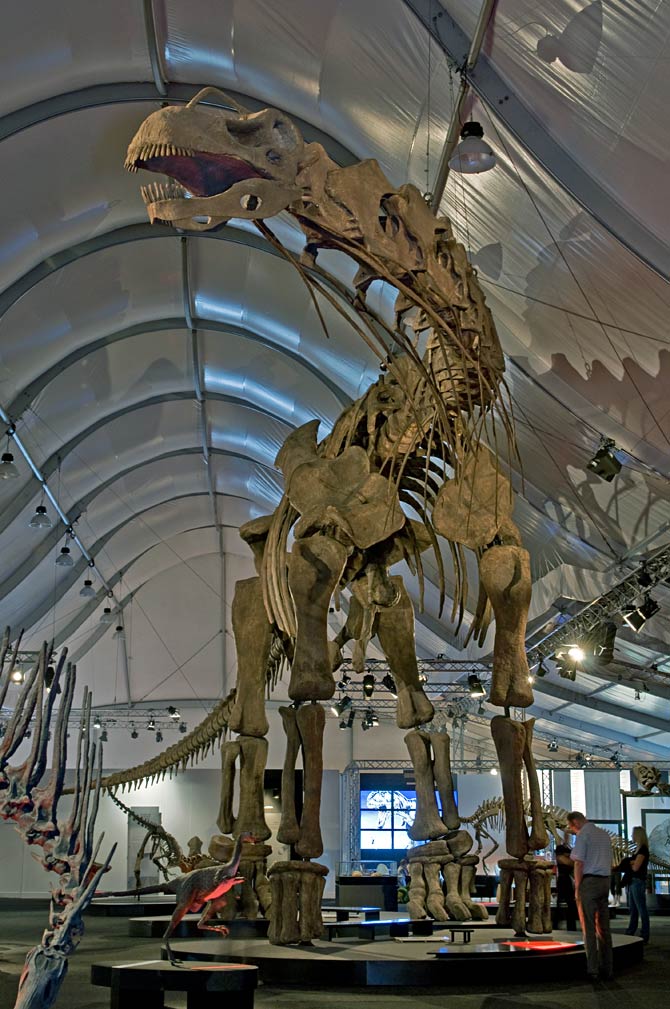
What was the largest creature ever to walk the earth?
Certainly, it was a dinosaur, and certainly a sauropod. Perhaps the biggest sauropods were the biggest creatures that ever existed, beating even the blue whale (record specimens measure more than 33 meters (110 feet), and the weight comes to 190 tons).
The statement is based on currently known excavations and estimates. As new discoveries are made, estimated dimensions and weights may change.
The biggest, truly known dinosaur, was Argentinosaurus. However, there are a few lesser-known candidates for the title of the biggest creation such as Amphicoelias or Sauroposeidon.
Check the article to the end, because after the first statement we present the latest update AD 2022
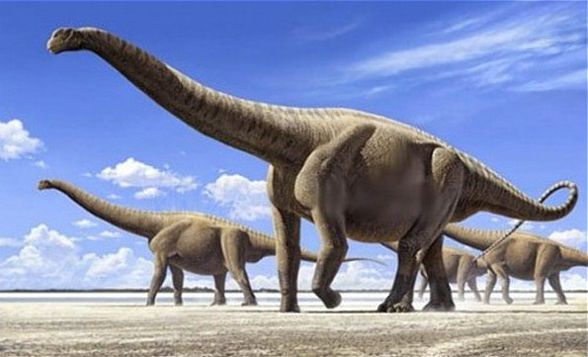
The largest and heaviest dinosaurs – TOP10
- Amphicoelias fragillimus: 100–150 t
- Argentinosaurus huinculensis: 50–90 t
- “Antarctosaurus” giganteus: 69–80 t
- Apatosaurus sp.: 36–80 t
- Giraffatitan brancai: 15–78 t (new estimates 23.3–40 t)
- Notocolossus: 45–76 t
- Mamenchisaurus sinocanadorum: 75 t
- Sauroposeidon proteles: 40–60 t
- Dreadnoughtus schrani: 59.3 t
- Paralititan stromeri: 20–59 t
- Unnamed (MPM-PV-39): 58 t
- Brachiosaurus altithorax: 28.7–56.3 t
- Turiasaurus riodevensis: 48–50.9 t
- Puertasaurus reuili: 50 t
- Ruyangosaurus giganteus: 50 t
- Futalognkosaurus dukei: 38.1–50 t
- Camarasaurus supremus: 9.3–47 t
- Elaltitan lilloi: 42.8 t
- Diplodocus hallorum (“Seismosaurus”): 30–42.5 t
- Tehuelchesaurus benitezii: 41.3 t
- Apatosaurus louisae: 16.4–41.3 t
- Supersaurus vivianae: 35–40.2 t
- Alamosaurus sanjuanensis: 32.7–35.2 t
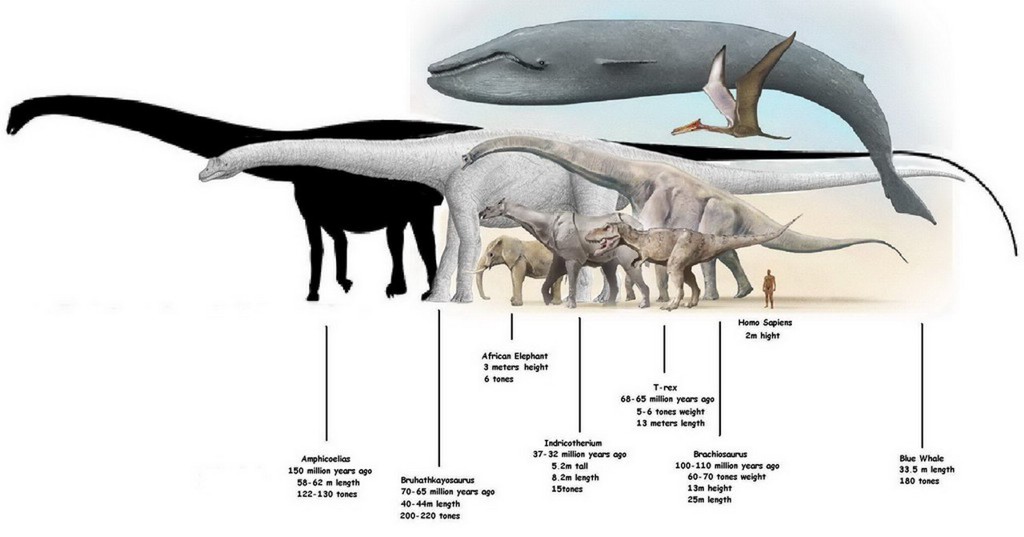
This is the world’s largest comparison of dinosaur weights.
The heaviest dinosaurs – update AD 2022
| No | Dinosaur | Weight [t] | Weight [kg] | Weight [lb] |
| 1 | Bruhathkayosaurus matleyi* | 78 t | 78 000 kg | 171 961 lb |
| 2 | Puertasaurus reuili | 70 t | 70 000 kg | 154 324 lb |
| 3 | Argentinosaurus huinculensis | 65 t | 65 000 kg | 143 300 lb |
| 4 | “Brachiosaurus” nougaredi | 64 t | 64 000 kg | 141 096 lb |
| 5 | Alamosaurus sanjuanensis | 62 t | 62 000 kg | 136 687 lb |
| 6 | Patagotitan mayorum | 55 t | 55 000 kg | 121 254 lb |
| 7 | Maraapunisaurus fragillimus | 50 t | 50 000 kg | 110 231 lb |
| 8 | Ruyangosaurus giganteus | 50 t | 50 000 kg | 110 231 lb |
| 9 | Brachiosaurus altithorax | 48 t | 48 000 kg | 105 822 lb |
| 10 | “Antarctosaurus” giganteus | 47 t | 47 000 kg | 103 617 lb |
| 11 | Sauroposeidon proteles | 45 t | 45 000 kg | 99 208 lb |
| 12 | “Huanghetitan” ruyangensis | 45 t | 45 000 kg | 99 208 lb |
| 13 | Paralititan stromeri | 44 t | 44 000 kg | 97 003 lb |
| 14 | Barosaurus lentus | 43 t | 43 000 kg | 94 799 lb |
| 15 | Notocolossus gonzalezparejasi | 41 t | 41 000 kg | 90 390 lb |
| 16 | Fusuisaurus zhaoi | 41 t | 41 000 kg | 90 390 lb |
| 17 | Giraffatitan brancai | 39 t | 39 000 kg | 85 980 lb |
| 18 | Supersaurus vivianae | 37 t | 37 000 kg | 81 571 lb |
| 19 | Yunmenglong ruyangensis | 37 t | 37 000 kg | 81 571 lb |
| 20 | Atlantosaurus montanus | 36 t | 36 000 kg | 79 366 lb |
| 21 | Xinjiangtitan shanshanesis | 34 t | 34 000 kg | 74 957 lb |
| 22 | Uberabatitan ribeiroi | 33 t | 33 000 kg | 72 753 lb |
| 23 | Austroposeidon magnificus | 32 t | 32 000 kg | 70 548 lb |
| 24 | Abdarainurus barsboldi | 32 t | 32 000 kg | 70 548 lb |
| 25 | “Mamenchisaurus” jingyanensis | 31 t | 31 000 kg | 68 343 lb |
| 26 | “Sauropodus” | 31 t | 31 000 kg | 68 343 lb |
| 27 | “Bananabendersaurus” | 31 t | 31 000 kg | 68 343 lb |
| 28 | Futalognkosaurus dukei | 30 t | 30 000 kg | 66 139 lb |
| 29 | Turiasaurus riodevensis | 30 t | 30 000 kg | 66 139 lb |
| 30 | Europatitan eastwoodi | 29 t | 29 000 kg | 63 934 lb |
| 31 | Hudiesaurus sinojapanorum | 28 t | 28 000 kg | 61 729 lb |
| 32 | Dreadnoughtus schrani | 28 t | 28 000 kg | 61 729 lb |
| 33 | “Blancocerosaurus” | 27 t | 26 500 kg | 58 423 lb |
| 34 | Fushanosaurus qitaiensis | 26 t | 26 000 kg | 57 320 lb |
| 35 | “Atlantosaurus” immanis | 25 t | 25 000 kg | 55 116 lb |
| 36 | Daxiatitan binglingi | 25 t | 25 000 kg | 55 116 lb |
| 37 | Traukutitan eocaudata | 25 t | 25 000 kg | 55 116 lb |
| 38 | Ultrasauros macintoshi | 25 t | 25 000 kg | 55 116 lb |
| 39 | “Angloposeidon” | 24 t | 24 000 kg | 52 911 lb |
| 40 | Argyrosaurus superbus | 23 t | 23 000 kg | 50 706 lb |
| 41 | Nullotitan glaciaris | 23 t | 22 500 kg | 49 604 lb |
| 42 | Jobaria tiguidensis | 23 t | 22 500 kg | 49 604 lb |
| 43 | Apatosaurus louisae | 22 t | 22 000 kg | 48 502 lb |
| 44 | Kaijutitan maui | 22 t | 21 500 kg | 47 399 lb |
| 45 | Lusotitan atalaiensis | 21 t | 21 000 kg | 46 297 lb |
| 46 | “Titanosaurus” falloti | 21 t | 21 000 kg | 46 297 lb |
| 47 | Jainosaurus septentrionalis | 21 t | 21 000 kg | 46 297 lb |
| 48 | Zby atlanticus | 21 t | 21 000 kg | 46 297 lb |
| 49 | Amphicoelias altus | 20 t | 20 000 kg | 44 092 lb |
| 50 | Jiangshanosaurus lixianensis | 20 t | 20 000 kg | 44 092 lb |
| 51 | Elaltitan lilloi | 20 t | 20 000 kg | 44 092 lb |
| 52 | Atlasaurus imelakei | 20 t | 20 000 kg | 44 092 lb |
*In 2022, the classification of Bruhathkayosaurus matleyi was changed and new analyzes indicated that it was not a sauropod, but a theropod. Hence it should be removed from the list.
The most recent data on the size of dinosaurs can be found by clicking on the dinosaur name or by searching directly in the Dinosaur Database: https://dinoanimals.com/dinosaurdatabase/
How do we estimate the weight of giant dinosaurs?
Determining the mass of extinct animals is far more complicated than simply measuring their bones. Unlike living animals, dinosaurs cannot be weighed directly, and many of the largest species are known only from fragmentary remains.


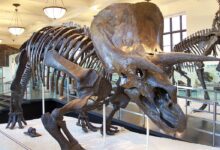
Early estimates often relied on rough comparisons with modern animals or scaling equations based on limb bones. These methods sometimes produced extreme results exceeding 100 tonnes (110 tons), particularly for poorly known taxa.
Today, paleontologists typically use more advanced techniques, including:
- 3D digital skeletal reconstructions
- volumetric body models
- biomechanical simulations
- comparisons with better-preserved relatives.
Even with modern methods, estimates can differ by many tonnes depending on assumptions about soft tissue, fat reserves, air sacs, and overall body proportions.
This uncertainty is especially important when discussing giant titanosaurs such as Patagotitan mayorum, Argentinosaurus huinculensis, or the controversial Maraapunisaurus fragillimus, whose fragmentary remains make precise calculations difficult.
Recommended







Ostatnio Shahen mi pisal, ze Argentynozaur ma 75 t i Puertazaur 57 t
Przepraszam, ze to pisze tutaj, a nie w Polskim dinoanimals, ale Tutaj jest update
Shahen w ostatnim czasie dokonuje rewizji zauropodów w oparciu o nowe materiały i być może stąd te zmiany, o których pisał, choć w przypadku puertazaura to byłyby bardzo duże zmiany.
Ja jeszcze ostatnio szacowałem B. matleyi
Oszacowałem na 37 – 38 m i 90 – 95 t
Dlaczego w ogóle go szacujecie, skoro nie ma żadnego materiału potwierdzającego jego istnienie?
Nie wiem. Oszacowania na podstawie Patagotitan, zakladajac, ze piszczel to kosc ramienna
37 m i 80 – 85 t
Polska w angielskim Dinoanimals….
Dlaczego nie odpowiadacie? Wasza lista jest nieprawidlowa (Shahen pisał, że argentynozaur ważył 75 t a puertazaur tylko 57) nawed wg. tego, kto miał kiedyś takie szacunki (Sahahen)
Anchi, przenieśmy tę dyskusję na polską wersję DinoAnimals, tam, aktualizacja powinna się pojawić wkrótce.
Pisze tutaj Anchiornis 🙂 (czyli Anchi ;))
Dobre oszacowania sa w ksiazce Dinosaur facts and figures: The sauropods and other Sauropodomorphs
Shahen tez tak pisze.
Redakcjo, co do apatozaura jest jeszcze Oklahoma’s Giant Apatosaurus, który wskazuje, że A. louisae osiągał ok. 28 – 30 m
Redakcjo, skąd informacja o rzekomych 70 tonach, puertazaur ważył 57 ton, patagotitan 55 ton, barachiozaur 55 Ton, Barosaurus Lentus osiągał większe rozmiary 60 t, co do alamozaur nie ważył 60 Ton bo piszczel na której szacowany to piszczelowa nie jest!!! I waży prawdopodobnie 38 t. Molina-peraz i larramendi dają Maraapunizaurowi 35 m natomiast waga to 70 Ton, również ten Argentynozaur nie wyszedł gdyż waży 75-80 ton.
Shahen ma w bazie też 70 ton dla puertazaura. Zapytaj go, ale na polskiej stronie Dino. To dane, które wspólnie zapewne opracowywali.
Ale Shahen pisał że ważył 57 ton
Ej czemu mi przemienienie Nick na Polski? Wiem że Wild Animal i dzikie zwierzę to to samo, ale to pierwsze lepiej brzmi.
Przecież to Angielskie więc czemu mi przemiania?
A, czyli żeby było Wild Animal muszę mieć po Angielsku. Ok? Zmieniam Nick Alamotyran.
Czemu mi ciągle na dzikie zwierze zmienia? Wild Animal lepiej brzmi.