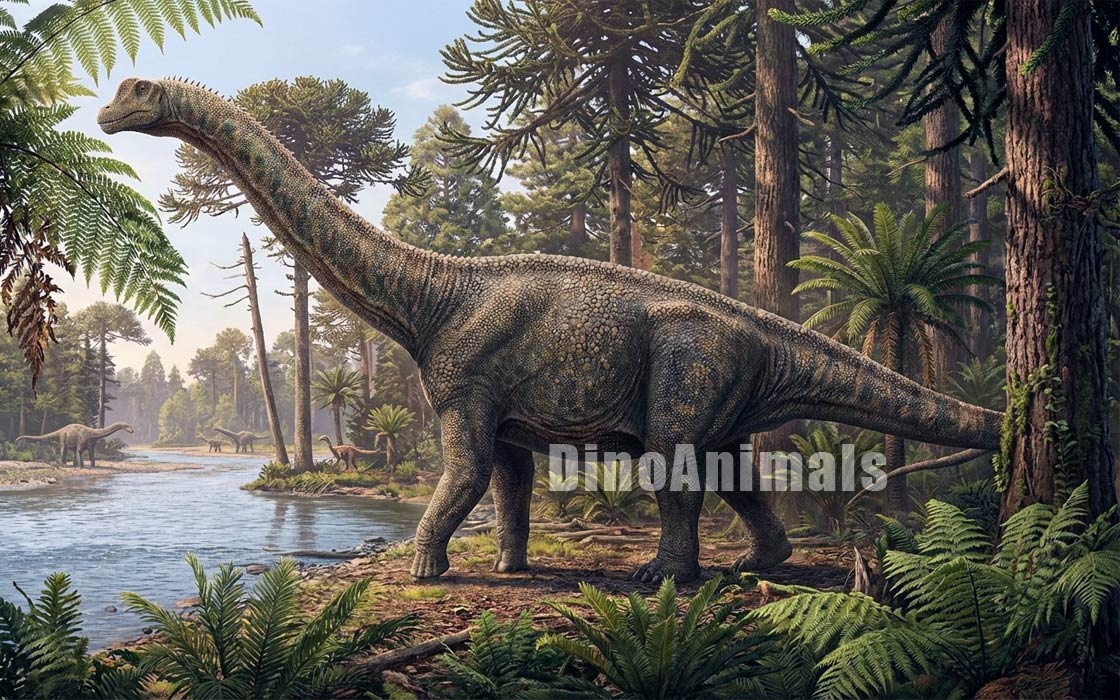
Dinosaur: Yeneen houssayi
| Length*: | 10 m | 32.8 ft |
| Weight*: | 6 t | 13,228 lb |
*The largest known specimen
Period
Epoch: Late Cretaceous
Stage: Santonian
Years: 86.3–83.6 Ma
Details
Status: valid
Author: Filippi et al.
Year: 2026
Distribution
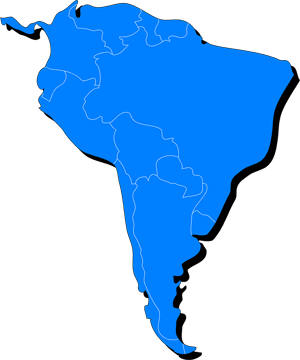
Area: South America
Country: Argentina
Region: Neuquén
Formation: Bajo de la Carpa
Description
Yeneen houssayi
Yeneen houssayi is a titanosaurian sauropod dinosaur from the Late Cretaceous (Santonian) Bajo de la Carpa Formation in the Cerro Overo – La Invernada area, North Patagonia, Argentina. Known from a partial disarticulated holotype skeleton and referred material, it represents a new genus and species within Saltasauroidea, highlighting significant titanosaur diversity in this formation. Described in 2026, this taxon co-occurs with other titanosaurs such as Bonitasaura, Inawentu, Overosaurus, and Rinconsaurus, contributing to understanding Santonian sauropod evolution in Gondwana.
Etymology
The generic name Yeneen derives from the Tehuelche (Aonikenk) cultural entity associated with cold and winter weather, referencing the type locality La Invernada (Spanish for “wintering place” for cattle). The specific epithet houssayi honors Bernardo Alberto Houssay, Argentine Nobel Prize winner in Physiology or Medicine (1947), who promoted the creation of CONICET, the national scientific research council.
Physical Characteristics
The holotype MAU-Pv-LI-538 consists of a partial disarticulated skeleton preserving axial elements: six cervical vertebrae, ten dorsal vertebrae, one caudal vertebra, a sacrum articulated with both ilia, and several ribs. These indicate a moderately long-necked titanosaur with robust dorsal vertebrae and a fused sacral complex. No cranial material or appendicular elements are preserved in the holotype.
A referred specimen MAU-Pv-LI-539 is an isolated right ilium from a smaller individual, assigned as cf. Yeneen houssayi, showing diagnostic features distinguishing it from other titanosaurs (e.g., specific iliac morphology). A third specimen MAU-Pv-LI-731 (disarticulated axial and appendicular bones) is under preparation and not formally referred.
Size estimates are based on comparisons to coeval saltasauroids in the Bajo de la Carpa Formation (e.g., Overosaurus ~8–10 m). The holotype’s axial skeleton suggests a length of 10–12 m (33–39 ft) and mass of 4–6 t, reflecting a medium-sized titanosaur with stocky build (ESR 3/4 due to partial preservation and reliance on clade scaling).
Diet and Feeding Habits
Herbivore; as a titanosaurian sauropod, likely a bulk browser feeding on high vegetation (e.g., conifers, ferns) using a long neck and peg-like teeth; gastroliths inferred for grinding.
Habitat and Distribution
South America, Argentina, Neuquén Province, Bajo de la Carpa Formation (Cerro Overo – La Invernada area).
Paleoenvironment
Fluvial and floodplain deposits in semi-arid to seasonal climate; co-occurring taxa include other titanosaurs (Bonitasaura salgadoi, Inawentu oslatus, Overosaurus paradasorum, Rinconsaurus caudamirus), abelisaurids, noasaurids, and small theropods.
Behavior and Social Structure
Inferred from clade: quadrupedal with gregarious tendencies; possible herding for protection; long neck for high browsing.
Discovery and Research
Holotype MAU-Pv-LI-538 collected from outcrops at La Invernada site; described in 2026 by Filippi et al. Referred MAU-Pv-LI-539 (isolated ilium) and MAU-Pv-LI-731 (under preparation). Phylogenetic analyses place it in Saltasauroidea (“Clade A”), diverging after Narambuenatitan but before Overosaurus.
Discovery Context
Excavated from Santonian sediments (~86–83 Ma) via stratigraphic correlation; housed in Museo Municipal Argentino Urquiza.
Significance and Interesting Facts
- Adds to high titanosaur diversity in Bajo de la Carpa Formation (at least five genera).
- Part of Saltasauroidea, showing early diversification in South America.
- Name ties indigenous Tehuelche culture and Argentine science (Houssay).
- Highlights Gondwanan titanosaur endemism in Santonian.
- Co-occurrence with other sauropods suggests niche partitioning.
- No referred cranial material, typical for many titanosaurs.
Conclusion
Yeneen houssayi exemplifies Santonian titanosaur diversity in North Patagonia, as a medium-sized saltasauroid contributing to the rich Bajo de la Carpa assemblage. Its partial axial skeleton and phylogenetic placement reveal evolutionary patterns in South American titanosaurs, with implications for dispersal and ecology. The 2026 description underscores the importance of ongoing fieldwork in revealing Gondwanan sauropod history.
Locations
Sources
Material: Six cervical vertebrae, ten dorsal vertebrae, one caudal vertebra, sacrum with both ilia, ribs (holotype MAU-Pv-LI-538); right ilium (referred MAU-Pv-LI-539); disarticulated axial and appendicular bones (MAU-Pv-LI-731, under preparation).
References: Filippi, Leonardo S.; Bellardini, Flavio; Carballido, José L.; Méndez, Ariel H.; Garrido, Alberto C. (2026-01-12). "Yeneen houssayi gen. et sp. nov. and an overview of the sauropod titanosaurian diversity from Cerro Overo – La Invernada area (Bajo de la Carpa Formation, Santonian), North Patagonia, Argentina".