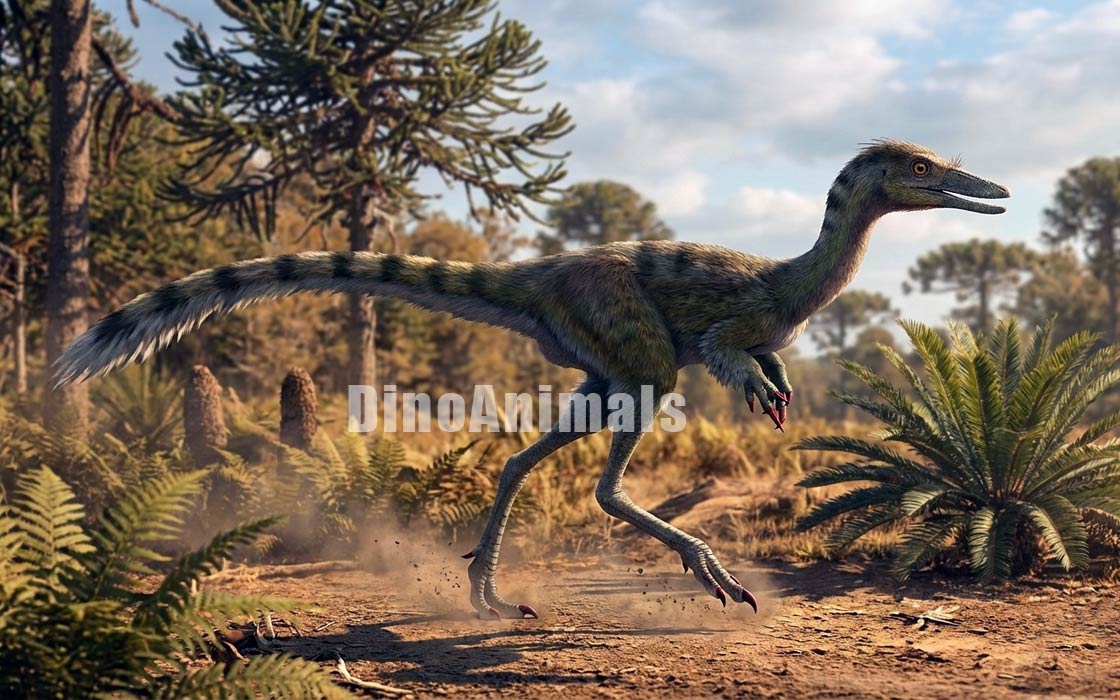
Dinosaur: Manipulonyx reshetovi
| Length*: | 1.2 m | 3.9 ft |
| Weight*: | 3.5 kg | 8 lb |
*The largest known specimen
Period
Epoch: Late Cretaceous
Stage: Maastrichtian
Years: 72.1–66 Ma
Details
Status: valid
Author: Averianov, Lopatin & Atuchin
Year: 2025
Distribution
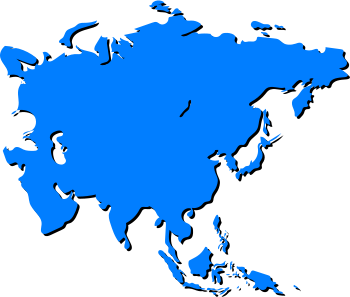
Area: Asia
Country: Mongolia
Region: Bayankhongor
Formation: Nemegt
Description
Manipulonyx reshetovi
Manipulonyx reshetovi is a small parvicursorine alvarezsaurid theropod from the Late Cretaceous (Maastrichtian) Nemegt Formation at Khermeen Tsav, Gobi Desert, Mongolia. Known from a single fragmentary holotype skeleton, it is distinguished by a uniquely complete forelimb preserving proximal carpals and dermal spikes, previously unknown in the clade. Described in 2025, this taxon supports hypotheses of ovivory in parvicursorines, with specialized forelimb adaptations for egg manipulation and puncture, contributing to understanding maniraptoran diversity and ecology in Late Cretaceous Asia.
Etymology
The generic name Manipulonyx derives from Latin “manipulare” (to manipulate or handle) and Greek “onyx” (claw), referring to the hypothesized manipulative function of its forelimb claws. The specific epithet reshetovi honors V. Yu. Reshetov, the Soviet paleontologist who discovered the holotype in 1979.
Physical Characteristics
- Vertebral column: two posterior cervical vertebrae (opisthocoelous, constricted centra without pleurocoels, lateral tubercles on ventral side), first dorsal vertebra, five sacral vertebrae, five caudal vertebrae; ultimate cervical smaller than penultimate; cervical ribs fused.
- Pectoral girdle: left scapulocoracoid with greater angle of scapular blade to suture.
- Forelimb: short and robust humerus (internal tuberosity projects proximal to head, hypertrophied deltopectoral crest without notch to head, enlarged ectepicondyle projecting distally, single distal condyle for radius-ulna articulation); hypertrophied olecranon on ulna; fused radius and ulna with visible suture; complete proximal carpals (ulnare, intermedium, radiale); carpometacarpus with medial tab, small central proximal facet, separate condyles for phalanx II-1; hypertrophied manual digit 2 with robust ungual phalanx (lacks flexor tubercle, convex extensor surface); greatly reduced digits 3-4; three dermal spikes (medial, lateral, palmar) articulated or attached to carpometacarpus, likely keratin-sheathed.
- Pelvic girdle: partial with arcuate supraacetabular crest on ilium not extending beyond pubic peduncle, larger ilium facet on pubis.
- Hindlimb: femur with entocondylar tuber directed posteriorly, open distal popliteal fossa; tibia with transversely wider posteromedial condyle similar to fibular condyle, deeper incisura tibialis; metatarsal 4 with lateral flexor ridge.
Manipulonyx is inferred to be small-bodied, comparable to Mononykus olecranus (~1.25 m length, 3.5 kg mass). Estimates assume similar proportions, with forelimb elements (e.g., humerus short and robust) scaling to a total length of ~1.2 m (3.9 ft) and weight ~3.5 kg (8 lb).
Diet and Feeding Habits
Ovivore (egg-eater); hypothesized to use dermal spikes (covered by keratinous sheaths) and rudimentary side fingers to fix forelimb on egg surface, puncturing shell with hypertrophied manual claw; supported by morpho-functional traits like deltopectoral crest for powerful flexion, keeled sternum for pectoral muscle attachment, ectepicondyle for extensor leverage, olecranon for elbow extension, and claw without flexor tubercle for puncture rather than grasping.
Habitat and Distribution
Asia, Mongolia, Govi-Altai Aimag, Nemegt Formation.
Paleoenvironment
Fluvial-lacustrine deposits in semi-arid floodplain; co-occurring taxa include turtles (Mongolochelys efremovi, Trionychidae, Nanhsiungchelyidae, Mongolemys sp., Gravemys barsboldi, Gravemys sp.), crocodylomorphs, sauropods, theropods (Therizinosaurus cheloniformis, Tarbosaurus bataar), ankylosaurs (Tarchia gigantea), ornithopods (Saurolophus angustirostris).
Behavior and Social Structure
Inferred from clade: cursorial with slender hindlimbs for speed; forelimbs specialized for ovivory, possibly nocturnal nest-raiding; no direct evidence for herding or sociality.
Discovery and Research
Holotype PIN 3142/364 discovered in 1979 by V. Yu. Reshetov at northern outcrops of Khermeen Tsav (Upper White Beds, Nemegt Formation); described in 2025 by Averianov, Lopatin, and Atuchin. No referred material. Phylogenetic position: Parvicursorinae within Alvarezsauridae (basal Maniraptora), monotypic genus; differs from relatives like Mononykus, Parvicursor, Ondogurvel in specific forelimb and postcranial traits.
Discovery Context
Excavated from Maastrichtian sediments via field collection; CT-scanned for 3D reconstruction; dated by stratigraphic correlation to Nemegt Formation.
Significance and Interesting Facts
- First parvicursorine with complete proximal carpals and dermal carpal spikes.
- Supports ovivory hypothesis for clade, with forelimb adaptations for egg manipulation.
- Challenges fossorial/insectivorous interpretations due to cursorial hindlimbs and reduced arm reach.
- Adds to Asian Late Cretaceous alvarezsaurid diversity, with potential for testing via eggshell puncture evidence.
- Honors discoverer Reshetov; reconstruction akin to Jaculinykus yaruui.
- Implies evolutionary trends toward miniaturization and forelimb reduction for specialized feeding.
Conclusion
Manipulonyx reshetovi provides crucial insights into parvicursorine forelimb anatomy and function, revealing proximal carpals and dermal spikes that support an ovivorous lifestyle. Its fragmentary but diagnostic skeleton from the Nemegt Formation highlights specialized maniraptoran adaptations in Late Cretaceous Asia, challenging prior ecological models and emphasizing egg predation as a key niche. This 2025 description enhances alvarezsaurid phylogeny and paleobiology, with implications for understanding theropod miniaturization and dietary diversification near the Cretaceous end.
Locations
Sources
Material: Two cervical vertebrae, one dorsal vertebra, five sacral vertebrae, five caudal vertebrae, left scapulocoracoid, forelimbs (humeri, radii, ulnae, carpals, metacarpals, phalanges), partial pelvic girdle, hindlimb fragments (femora, tibiae, metatarsals) (holotype PIN 3142/364).
References: Averianov, Alexander O.; Lopatin, Alexey V.; Atuchin, Andrey A. (2025-12-23). "Forelimb structure and function in a new Late Cretaceous parvicursorine theropod dinosaur from Mongolia"