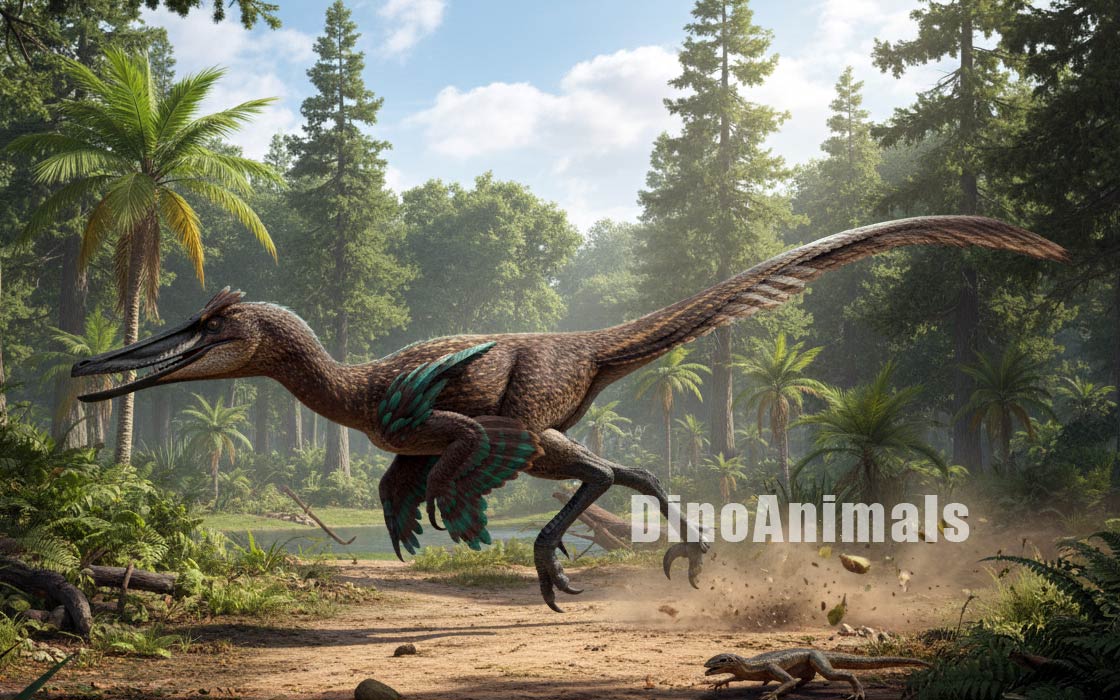
Dinosaur: Austroraptor cabazai
| Length*: | 5.6 m | 18.4 ft |
| Weight*: | 320 kg | 705 lb |
| Speed: | 38 km/h | 24 mph |
*The largest known specimen
Period
Epoch: Late Cretaceous - 72–66
Stage: Campanian-Maastrichtian
Years: 83.6–66 Ma
Details
Status: valid
Author: Novas et al.
Year: 2008
Distribution
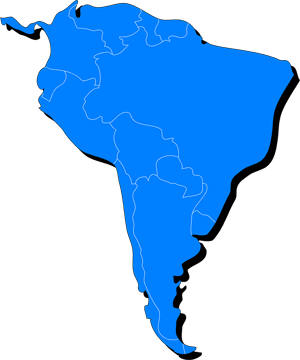
Area: South America
Country: Argentina
Region: Río Negro
Formation: Allen
Description
Austroraptor cabazai
Austroraptor cabazai is a large unenlagiine theropod from the Late Cretaceous Allen Formation of Río Negro Province, Argentina. Known from two partial skeletons, it represents one of the largest known dromaeosaurids from the Southern Hemisphere, characterized by an elongated low skull, conical non-serrated teeth, and short forelimbs. Described in 2008 and supplemented in 2012, recent 2025 osteological redescription provides updated anatomy and supports its position as a gigantic southern unenlagiid, potentially reclassified as a basal avialan in some analyses. This taxon highlights faunal differences and convergences between Northern and Southern Hemisphere theropods during the Maastrichtian.
Etymology
The genus name Austroraptor combines Latin “auster” (south wind) and “raptor” (thief), alluding to its southern origin as a predator. The specific epithet cabazai honors Alberto Cabaza, founder of the Lamarque Museum where the holotype was studied.
Physical Characteristics
The skull of Austroraptor cabazai is low and elongated (~80 cm / 31 in), with a lacrimal featuring an anteriorly curved descending process and a reduced dorsomedial process on the postorbital. The maxilla is shallow with 9–11 alveoli, bearing small, conical, non-serrated teeth that are fluted and curved, resembling those of spinosaurids. The dentary is slender with ~15 alveoli, and teeth lack serrations, suggesting piscivory or soft-prey specialization. The frontal is triangular, and the postorbital lacks a pronounced dorsal rim.
The axial skeleton includes elongated cervical vertebrae with reduced pleurocoels, mid-caudals with tall neural spines, and a robust tail. The humerus is short (46% of femur length), with a pronounced deltopectoral crest; the radius and ulna are slender, with the ulna bowed and featuring a semilunate carpal. Manual elements include metacarpal I and phalanges, with unguals curved for grasping. The pubis has a distal boot, the femur is robust (~80 cm / 31 in) with a low fourth trochanter, the tibia is slender with a fused fibula distally, and the metatarsus is subarctometatarsal with metatarsal III pinched proximally. Pedal phalanges show digit IV robust, with phalanx IV-2 nearly as wide as long, though reidentification in the referred specimen suggests normal proportions.
Body size estimates for the holotype indicate ~5 m (16 ft) length and 300 kg (660 lb) mass, based on femoral dimensions and comparisons to Velociraptor mongoliensis. Some analyses suggest up to 6 m (20 ft) and 500 kg (1,102 lb), using volumetric models calibrated to unenlagiine gracility. The referred specimen (MML 220) is slightly smaller, ~10% reduced in linear dimensions, confirming adult variation. These estimates are moderately reliable (ESR 3/4) due to partial skeletons but multiple comparable elements.
Recent 2025 redescription (Motta and Novas) details new elements like the quadrate, refining cranial pneumatization and postcranial robustness, emphasizing its gigantic size among southern paravians.
Diet and Feeding Habits
Carnivore; conical, non-serrated teeth suggest piscivory or feeding on soft-bodied prey, analogous to spinosaurids; short arms limit manipulation, implying ambush or pursuit predation on fish, small vertebrates, or carrion; unenlagiine gracile limbs indicate cursorial hunting of agile prey.
Habitat and Distribution
South America, Argentina, Río Negro Province, Allen Formation.
Paleoenvironment
Terrestrial fluvial and lacustrine deposits in a semi-arid floodplain; co-occurring taxa include titanosaurs (Saltasaurus loricatus, Aeolosaurus colhuehuapensis), hadrosaurids (Bonapartesaurus rionegrensis), abelisaurids (Quilmesaurus curriei), birds (Limenavis patagonica), crocodylomorphs, turtles, snakes, and mammals; vegetation sparse with conifers and ferns.
Behavior and Social Structure
Inferred from clade: bipedal cursorial predator with potential pack hunting based on dromaeosaurid analogs; short arms suggest reliance on jaws and feet for capture; possible semiaquatic habits for fishing; no direct evidence for sociality.
Discovery and Research
Holotype MML 195 discovered in 2002 by Fernando Novas’ team at Bajo de Santa Rosa; described in 2008. Referred MML 220 found in 2008, described in 2012 by Currie and Paulina-Carabajal, adding forelimb and pes elements. Phylogenetic analyses place it in Unenlagiinae (Dromaeosauridae), sister to Buitreraptor gonzalezorum or Ypupiara lopai; 2025 studies (Motta et al.) recover unenlagiines as basal avialans closer to birds than dromaeosaurids, with updated diagnosis emphasizing cranial and limb traits.
Discovery Context
Excavated from Maastrichtian sandstones (~72–66 Ma) via stratigraphic correlation; prepared mechanically; CT scans reveal braincase.
Significance and Interesting Facts
- Largest South American dromaeosaurid, highlighting Gondwanan gigantism in paravians.
- Non-serrated teeth suggest dietary convergence with spinosaurids.
- Supports breakdown of hemispheric faunal barriers in Late Cretaceous.
- 2025 redescription refines anatomy, proposes basal avialan status for unenlagiines.
- No cultural depictions noted, but inspires models of southern raptors.
- Refutes early chimera hypotheses for pedal morphology.
Conclusion
Austroraptor cabazai exemplifies Late Cretaceous theropod diversity in Patagonia, as a large unenlagiine with specialized feeding adaptations. Its partial skeletons provide key insights into unenlagiid anatomy and phylogeny, with recent reclassifications as basal avialans challenging traditional dromaeosaurid placements. Discoveries in the Allen Formation underscore Gondwanan endemism and convergence, contributing to understanding paravian evolution toward flight-capable forms near the Cretaceous end.
Locations
Sources
Material: Two partial skeletons with fragmentary skulls. Right frontal, postorbital, lacrimals, maxillae, dentaries, surangular, prearticular, cervicals, dorsals, ribs, gastralia, right humerus, manual ungual III, left pubic shaft, left femur, right tibia, astragalus, calcaneum, metatarsal III, pedal phalanges (holotype MML 195); maxillary fragments, teeth, dorsal vertebra, caudals, left humerus, radii, ulnae, metacarpals I, manual phalanges, tibia, metatarsals II III, pedal phalanges (referred MML 220).
References: Currie and Paulina Carabajal, (2012). A new specimen of Austroraptor cabazai Novas, Pol, Canale, Porfiri and Calvo, 2008 (Dinosauria, Theropoda, Unenlagiidae) from the Latest Cretaceous (Maastrichtian) of Rio Negro, Argentina. Novas F.E., Pol D., Canale J.I., Porfiri J.D., Calvo J.O. 2009. A bizarre Cretaceous theropod dinosaur from Patagonia and the evolution of Gondwanan dromaeosaurids. Proceedings of the Royal Society B, 276(1659):1101–1107. DOI: 10.1098/rspb.2008.1554; Currie P.J., Paulina-Carabajal A. 2012. A new specimen of Austroraptor cabazai Novas, Pol, Canale, Porfiri and Calvo, 2008 (Dinosauria, Theropoda, Unenlagiidae) from the latest Cretaceous (Maastrichtian) of Río Negro, Argentina. Ameghiniana, 49(4):662–667. DOI: 10.5710/AMGH.30.8.2012.599; Motta M.J., Novas F.E. 2025. Osteology of Austroraptor cabazai (Paraves: Theropoda), a southern gigantic unenlagiid from the Late Cretaceous of Patagonia. Journal of Vertebrate Paleontology.