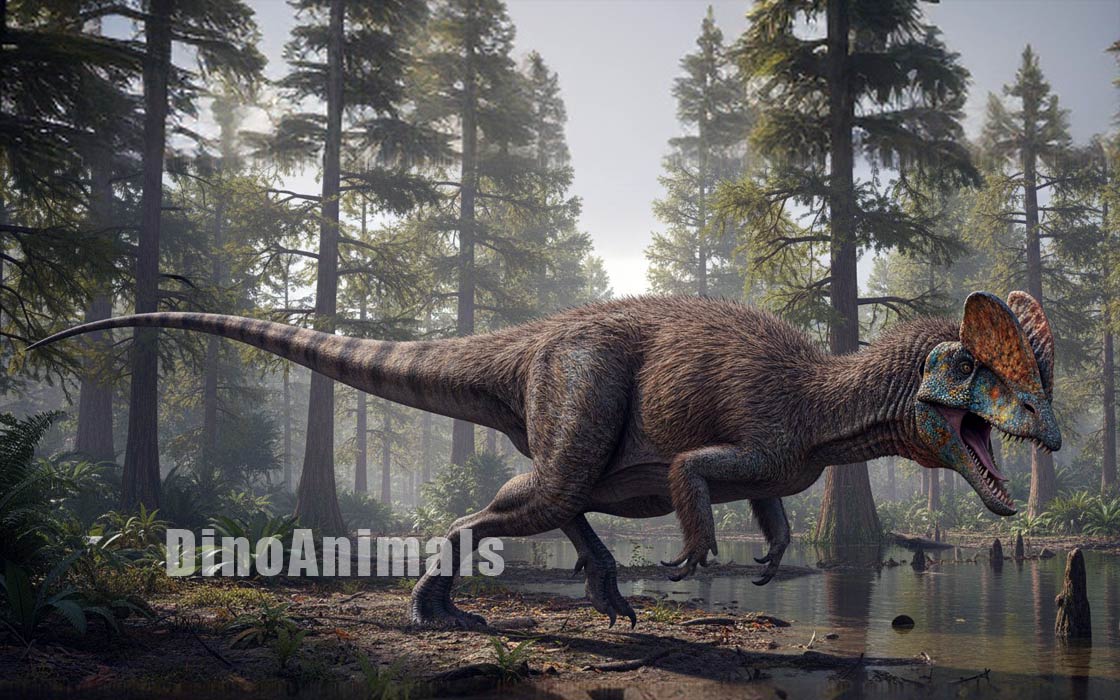
Dinosaur: Dilophosaurus wetherilli
| Length*: | 6.3 m | 20.7 ft |
| Weight*: | 350 kg | 772 lb |
| Speed: | 37 km/h | 23 mph |
*The largest known specimen

Period
Epoch: Early Jurassic
Stage: Sinemurian-Pliensbachian
Years: 199.3–182.7 Ma
Details
Status: valid
Author: Welles
Year: 1970
Distribution
Area: North America
Country: USA
Region: Arizona
Formation: Kayenta
Description
Dilophosaurus wetherilli
Dilophosaurus wetherilli is a large-bodied theropod dinosaur from the Early Jurassic Kayenta Formation of northern Arizona, United States. Known from five skeletons, including the nearly complete holotype and larger referred specimens, it represents the earliest known large predator in North America, with distinctive parasagittal nasolacrimal crests and derived axial features. Redescription in 2020 confirms a single species, refuting previous taxonomic divisions, and places it as a non-averostran neotheropod outside Coelophysoidea, highlighting evolutionary transitions across the Triassic-Jurassic boundary.
Etymology
The genus name Dilophosaurus derives from Ancient Greek “di” (two), “lophos” (crest), and “sauros” (lizard), referring to the two crests on the skull. The specific epithet wetherilli honors explorer John Wetherill, who assisted in the discovery.
Physical Characteristics
The skull of Dilophosaurus wetherilli is elongate and lightly built, with a subnarial gap between the premaxilla and maxilla, and prominent paired nasolacrimal crests formed by the premaxilla, nasal, and lacrimal bones. The premaxilla bears four alveoli with curved, serrated teeth; the maxilla has 12–14 alveoli, with teeth increasing in length anteriorly. The nasal is dorsoventrally expanded, contributing to the crest, which is tallest above the antorbital fenestra. The lacrimal is tall with a posterior process, and the jugal forms a “chin” ventrally. The braincase features a trapezoidal supraoccipital and fused exoccipital-opisthotic, with cranial nerves I–XII identifiable.
The axial skeleton shows serial variation: the atlas-axis complex has a coossified pleurocentrum-intercentrum; cervical vertebrae exhibit a bifurcating posterior centrodiapophyseal lamina that reunites caudally, with epipophyses on cervicals 3–9. Dorsal vertebrae have hollow centra and tall neural spines; the sacrum comprises five vertebrae with fused ribs. The tail has up to 45 vertebrae, with bifurcated neural spines anteriorly and elongated prezygapophyses in mid-caudals for stiffening.
The pectoral girdle includes a dorsoventrally expanded scapula blade and triangular coracoid. The humerus is half the femur length, with a deltopectoral crest; the manus has four digits, with large claws on I–III. The pelvis has a concave ilium blade, perforated acetabulum, and boot-like pubis. The femur is sigmoidal with a trochanteric shelf; the tibia is subequal in length, with a fibular crest; the pes has four functional toes, with metatarsal V reduced.
Body size estimates vary by specimen and ontogeny. The holotype (UCMP 37302) represents a subadult ~6 m (20 ft) long, based on articulated skeleton length. The largest specimen (UCMP 77270) is estimated at ~7 m (23 ft) from femur proportions (0.64 m vs. holotype 0.59 m), indicating potential growth to larger sizes. Weight is derived volumetrically, with holotype ~283–300 kg (624–660 lb) and largest ~400 kg (880 lb), calibrated to lightweight theropod densities and comparisons to Coelophysis bauri. These are reliable due to near-complete skeletons (ESR 4/4), though subadult status adds minor uncertainty.
Diet and Feeding Habits
Carnivore; as a macropredator, likely hunted large prey such as prosauropods (e.g., Sarahsaurus aurifontanalis) and smaller vertebrates, possibly including fish based on jaw structure resembling spinosaurids; serrated teeth for slicing flesh; evidence of bite marks on coeval sauropodomorphs suggests predation or scavenging.
Habitat and Distribution
North America, United States, Arizona (Navajo Nation), Kayenta Formation.
Paleoenvironment
Fluvial and floodplain deposits in semi-arid seasonal climate with rivers, oases, and sand dunes; vegetation included conifers (e.g., Araucaria); co-occurring taxa include Scutellosaurus lawleri, Sarahsaurus aurifontanalis, Kayentatherium wellesi, tritylodontids, crocodylomorphs (e.g., Kayentasuchus walkeri), frogs, salamanders, turtles, hybodont sharks, lungfish, and pterosaurs.
Behavior and Social Structure
Inferred from clade and traces: bipedal locomotion with high metabolism supported by unidirectional airflow; possible gregariousness from clustered specimens and trackways (e.g., Dilophosauripus williamsi); crests for display in species recognition or sexual selection; grasping forelimbs for prey capture; rapid growth in early ontogeny.
Discovery and Research
Holotype UCMP 37302 (nearly complete skeleton) and paratype UCMP 37303 discovered in 1940–1942 by Jesse Williams and excavated by Samuel P. Welles near Tuba City; larger specimen UCMP 77270 in 1964 by Welles; additional specimens TMM 43646-1 and TMM 47006-1 in 2001 and 2010 by University of Texas teams near Rock Head. Originally named Megalosaurus wetherilli in 1954, renamed Dilophosaurus in 1970; comprehensive redescription in 2020 resolves taxonomy and phylogeny as non-averostran neotheropod, sister to Cryolophosaurus ellioti + Zupaysaurus rougieri; refutes “Dilophosauridae” as non-monophyletic.
Discovery Context
Collected from siltstone and sandstone facies of the Kayenta Formation (~195–183 Ma, Sinemurian–Pliensbachian, based on U-Pb dates from associated strata); holotype quarry in lower “silty facies,” others in middle third; prepared with needles, air scribes, and consolidants; CT scans reveal braincase anatomy.
Significance and Interesting Facts
- Earliest large-bodied theropod in North America, marking increase in size across Triassic-Jurassic boundary.
- Crests plesiomorphic for stem-averostrans, shared with early ceratosaurs and tetanurans.
- Derived axial features (e.g., lamina variation, hollow vertebrae) linked to macropredation and high metabolism.
- Misrepresented in media (e.g., Jurassic Park with frill and venom, absent in fossils).
- Trackways (Dilophosauripus, Kayentapus) suggest behavior and wider distribution.
- Monotypic genus confirmed by phylogeny; resolves debates on multiple taxa or Chinese species (Sinosaurus).
Conclusion
Dilophosaurus wetherilli exemplifies early theropod diversification in the Early Jurassic, with unique cranial crests and advanced postcranial adaptations facilitating large size and predation. Its redescription clarifies anatomy, supports monotypy, and positions it as a key stem-averostran, bridging Late Triassic small-bodied forms and later averostrans. Discoveries in the Kayenta Formation underscore North American faunal changes post-Triassic extinction, with implications for theropod evolution toward avian traits.
Locations
Sources
Material: Several partial skeletons with skulls and single fragments. Nearly complete skeleton (holotype UCMP 37302), partial skeleton (paratype UCMP 37303), nearly complete skeleton (UCMP 77270), partial skeleton (TMM 43646-1), braincase and partial postcrania (TMM 47006-1).
References: Marsh, (2015). A comprehensive study of Dilophosaurus wetherilli: Anatomy, taxonomy, and evolutionary relationships of the first large-bodied theropod in North America.
Marsh A.D., Rowe T.B. 2020. A comprehensive anatomical and phylogenetic evaluation of Dilophosaurus wetherilli (Dinosauria, Theropoda) with descriptions of new specimens from the Kayenta Formation of northern Arizona. Journal of Paleontology.