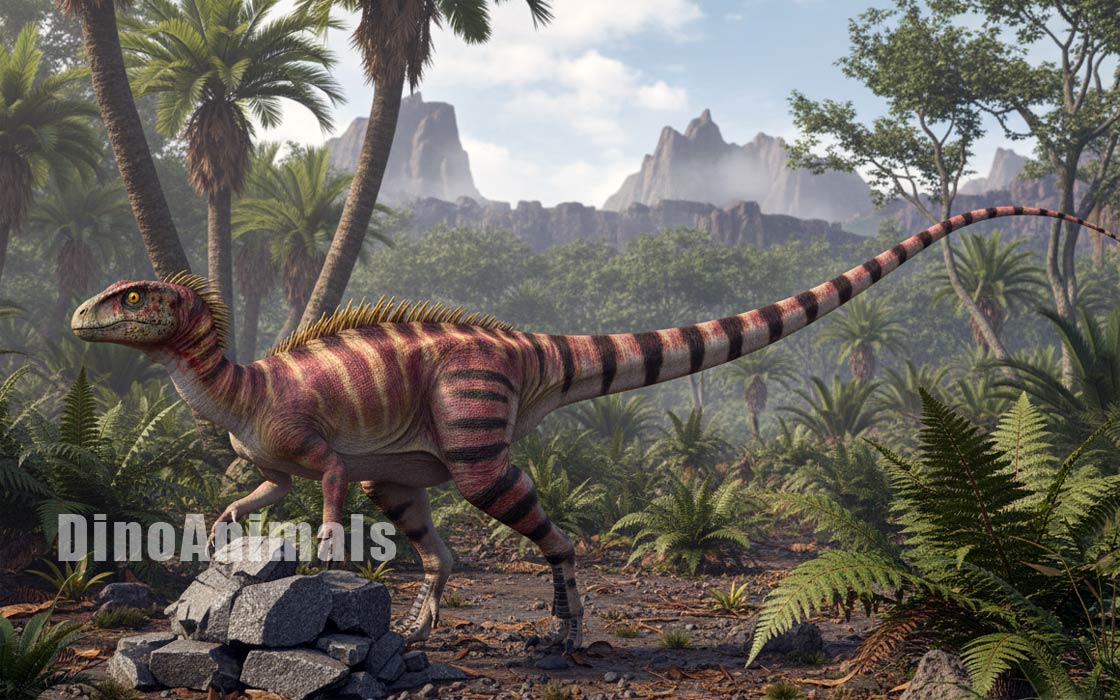
Dinosaur: Abrictosaurus consors
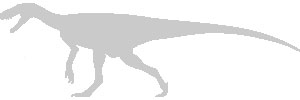
| Length*: | 83 cm | 2.7 ft |
| Weight*: | 1 kg | 2 lb |
*The largest known specimen
Period
Epoch: Early Jurassic
Stage: Hettangian-Sinemurian
Years: 201.4–190.8 Ma
Details
Status: valid
Author: Hopson
Year: 1975
Distribution
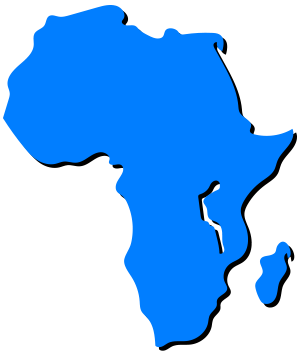
Area: Africa
Country: Lesotho
Region: Qacha's Nek
Formation: Upper Elliot
Description
Abrictosaurus consors
Abrictosaurus consors is a small-bodied heterodontosaurid ornithischian from the Early Jurassic Upper Elliot Formation of southern Lesotho, measuring approximately 0.8-1.2 m in length and 1-1.2 kg in weight based on scaling from the related Heterodontosaurus tucki. Known from a single partial skull and articulated skeleton, it represents one of the basal members of Heterodontosauridae, notable for reduced caniniform teeth and distinctive maxillary and dentary crown morphology that suggests specialized herbivory in a semiarid paleoenvironment shared with sauropodomorphs like Massospondylus.
Etymology
The genus name Abrictosaurus derives from Greek “abriktos” (wakeful) and “sauros” (lizard), referencing disagreement with the hypothesis of aestivation in heterodontosaurids proposed by Thulborn. The species name consors is Latin for “companion” or “spouse,” originally applied when described as Lycorhinus consors.
Physical Characteristics
- Premaxillary teeth with tall, subcylindrical crowns on teeth 2 and 3, the latter possibly a reduced caniniform.
- Dentary tooth 2 with subcylindrical crown, possibly a reduced caniniform.
- Maxillary and dentary teeth with flat lateral and medial crown surfaces lacking discrete marginal or median ridges.
- Maxillary crowns in the middle of the tooth row with deep parallel-sided proportions that do not expand mesiodistally toward the apex.
- Absence of well-formed dentary or premaxillary caniniform teeth, though subcylindrical crowns may represent reductions.
- Forelimb with deltopectoral crest on humerus approximately 34% of humeral length; manus with elongate metacarpals relative to humerus.
- Hindlimb with femur bowed, pendant fourth trochanter proximal to mid-shaft, and no anterior intercondylar groove.
Size estimates are based on the holotype NHMUK RU B54, with skull length approximately 145 mm (71% of adult Heterodontosaurus tucki skull at 205 mm) and femur length 68% of H. tucki, suggesting a subadult individual; adult body size likely comparable to H. tucki at 1.2 m length, with weight scaled proportionally from H. tucki estimates (logic from Sereno 2012 comparisons and Benson et al. 2017 body size evolution data).
Diet and Feeding Habits
Herbivore; heterodont dentition with beak for cropping vegetation, reduced caniniforms, and cheek teeth adapted for shearing plant material. Tooth-to-tooth wear and jaw mechanics indicate processing of fibrous vegetation, with no evidence for carnivory despite caniniform presence.
Habitat and Distribution
Africa, Lesotho, Upper Elliot Formation.
Paleoenvironment
Fluvial-aeolian depositional setting in a semiarid climate with sporadic rainfall, preserving sand dunes and seasonal floodplains; co-occurring taxa include theropod Megapnosaurus, sauropodomorph Massospondylus, other heterodontosaurids (Heterodontosaurus, Lycorhinus), terrestrial crocodylomorphs, cynodonts, and early mammals.
Behavior and Social Structure
Inferred from heterodontosaurid clade: small-bodied herbivore likely foraging in groups; reduced caniniforms suggest minimal agonistic behavior compared to taxa with prominent tusks; no direct evidence for herding or predation style.
Discovery and Research
Holotype NHMUK RU B54, collected 1963–1964 by K. Kermack and F. Mussett, described 1974 as Lycorhinus consors by Thulborn, transferred to Abrictosaurus consors by Hopson in 1975. Referred material: none confirmed; phylogenetic position as basal heterodontosaurid within Heterodontosaurinae.
Discovery Context
Stream-side exposure near Nosi, Lesotho; dated via stratigraphic correlation to Hettangian (earliest Jurassic), approximately 202–197 Ma.
Significance and Interesting Facts
- One of the most basal heterodontosaurids, providing insights into early ornithischian evolution and heterodonty.
- Reduced caniniform teeth sparked debates on sexual dimorphism in dinosaurs.
- Evidence of active tooth replacement challenges earlier aestivation hypotheses.
- Coexists with diverse Early Jurassic fauna, highlighting southern Gondwanan ecosystems.
- Contributes to understanding masticatory function in small herbivores.
- Featured in studies on dinosaur body size evolution (e.g., Benson et al. 2017).
Conclusion
Abrictosaurus consors exemplifies the diversity of early heterodontosaurids, with its reduced caniniforms and specialized cheek teeth reflecting adaptations for herbivory in arid environments. As a basal member of the clade, it bridges primitive ornithischians and more derived forms like Heterodontosaurus, underscoring the rapid radiation of small-bodied herbivores in the Early Jurassic. Ongoing research may clarify ontogenetic variation and phylogenetic relationships, enhancing our view of ornithischian origins.
Locations
Sources
Material: Partial skull and articulated skeleton lacking mid and distal caudal vertebrae, right coracoid, left carpus, portions of left manus, and portions of right hindlimb (holotype).
References: Sereno, P. (2012). "Taxonomy, morphology, masticatory function and phylogeny of heterodontosaurid dinosaurs".